Agonistics by Chantal Mouffe
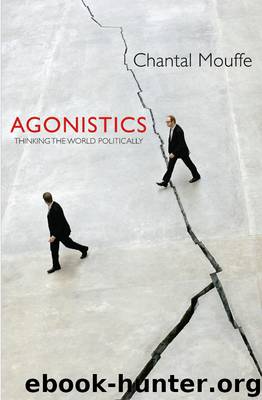
Author:Chantal Mouffe [Mouffe, Chantal]
Language: eng
Format: epub
ISBN: 978-1-78168-235-7
Publisher: Verso Books
Published: 2013-07-02T04:00:00+00:00
CRITIQUE AS HEGEMONIC ENGAGEMENT WITH
In contrast to this strategy of ‘withdrawal’, I want to offer a different conception of radical politics envisaged in terms of ‘engagement’ with institutions, with the aim of bringing about a different hegemony. I agree with the previous writers on the need to take account of the crucial transformations in the mode of the regulation of capitalism brought about by the transition from fordism to post-fordism. In addition, it is necessary not to judge those transformations as the mere consequence of technological progress. In my view, however, this transition is better apprehended within the framework of the theory of hegemony. Many factors have contributed to this transition, and it is necessary to recognize their complex articulation.
The problem with the operaist and post-operaist viewpoints is that they tend to see the transition from fordism to post-fordism as driven by one single logic: workers’ resistance to the process of exploitation, which forces the capitalists to reorganize the process of production and to move to post-fordism, where immaterial labour is central. For them, capitalism can only be reactive; they refuse to accept the creative role played by both capital and labour. What they deny is in fact the role played in this transition by the hegemonic struggle.
To envisage the transition from fordism to post-fordism in terms of an hegemonic struggle means abandoning the view that one single logic – workers’ struggles – is at work in the evolution of the work process. It means acknowledging the pro-active role played by capital in this transition. In order to grasp this role, we can find interesting insights in the work of Luc Boltanski and Eve Chiapello. In their book The New Spirit of Capitalism, they bring to light the way in which capitalists managed to use the demands for autonomy made by the new movements that developed in the ’60s, harnessing them in the development of the post-fordist networked economy and transforming them into new forms of control.3 What they call ‘artistic critique’ to refer to the aesthetic strategies of the counter-culture – the search for authenticity, the ideal of self-management, the anti-hierarchical exigency – was used to promote the conditions required by the new mode of capitalist regulation, replacing the disciplinary framework characteristic of the fordist period.
From my point of view, what is important in this approach is that it shows how a crucial aspect of the transition from fordism to post-fordism consisted in a process of discursive re-articulation of existing discourses and practices. This is why it allows us to visualize this transition in terms of an hegemonic intervention. To be sure, Boltanski and Chiapello never use this vocabulary, but their analysis is a clear example of what Gramsci called ‘hegemony through neutralization’ or ‘passive revolution’, a situation where demands which challenge the hegemonic order are appropriated by the existing system so as to satisfy them in a way that neutralizes their subversive potential.
When the transition from fordism to post-fordism is apprehended within such a framework, we can understand
Download
This site does not store any files on its server. We only index and link to content provided by other sites. Please contact the content providers to delete copyright contents if any and email us, we'll remove relevant links or contents immediately.
| Anthropology | Archaeology |
| Philosophy | Politics & Government |
| Social Sciences | Sociology |
| Women's Studies |
The remains of the day by Kazuo Ishiguro(9004)
Tools of Titans by Timothy Ferriss(8403)
Giovanni's Room by James Baldwin(7352)
The Black Swan by Nassim Nicholas Taleb(7137)
Inner Engineering: A Yogi's Guide to Joy by Sadhguru(6799)
The Way of Zen by Alan W. Watts(6621)
The Power of Now: A Guide to Spiritual Enlightenment by Eckhart Tolle(5789)
Asking the Right Questions: A Guide to Critical Thinking by M. Neil Browne & Stuart M. Keeley(5779)
The Six Wives Of Henry VIII (WOMEN IN HISTORY) by Fraser Antonia(5519)
Astrophysics for People in a Hurry by Neil DeGrasse Tyson(5196)
Housekeeping by Marilynne Robinson(4455)
12 Rules for Life by Jordan B. Peterson(4312)
Double Down (Diary of a Wimpy Kid Book 11) by Jeff Kinney(4278)
Ikigai by Héctor García & Francesc Miralles(4278)
The Ethical Slut by Janet W. Hardy(4262)
Skin in the Game by Nassim Nicholas Taleb(4256)
The Art of Happiness by The Dalai Lama(4133)
Skin in the Game: Hidden Asymmetries in Daily Life by Nassim Nicholas Taleb(4012)
Walking by Henry David Thoreau(3968)
